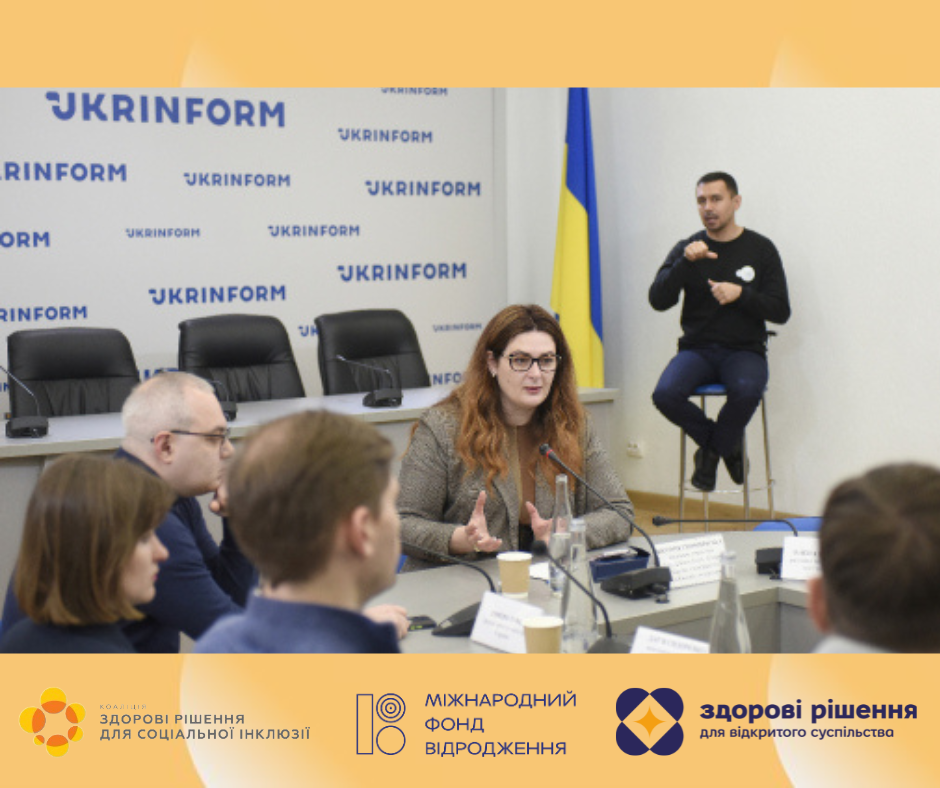
On April 18, representatives from government bodies and NGOs gathered for a roundtable discussion to explore the "Perspectives on the Implementation of the Medical-Social Expertise Reform in 2024."
"Our goal is to determine a path that aligns with everyone’s right to dignity, freedom, and safety," said Victoria Timoshevskaya.
The full-scale war in Ukraine has now been ongoing for three years, yet there is still no streamlined procedure for veterans to obtain disability status. As noted by Daria Sydorenko from the NGO "League of the Strong," surveys indicate that there are many barriers to achieving disability status. The aim of today’s meeting was to outline the prospects for the development and advancement of the MSEK reform and to discuss what changes can be implemented right "here and now" through joint efforts from the public and state sectors to simplify the process of obtaining disability status and expedite the provision of rehabilitation and social services.
Agenda Items Included:
Prospects for implementing the draft law on the reform of medical-social expertise in Ukraine: reform concept, current status, and potential for implementation by year-end, as well as operation within a transitional period.
The urgent need for quick changes in the operations of MSEK: amendments to the CMU Resolution "On Medical-Social Expertise" (1317) and the Regulation on the Individual Rehabilitation Program (757). How will the proposed changes affect the MSEK procedure? Timeline for implementing changes. Steps by government bodies and NGOs towards ensuring the MSEK reform by the end of 2024.
Video Recording of the Roundtable Discussion
Achieving Consensus for Strategic Decisions and Stakeholder Interaction
The expected outcome of the meeting for both government representatives and NGOs was to reach a consensus on decision-making at a strategic level and to discuss how interaction among various stakeholders could be ensured for effective reform implementation.
How do we envision this interaction, how can it be optimized and established? The answer lies in consistent systematic collaboration to transition from strategic to technical levels. NGOs play a driving role in protecting veterans' rights; they are the force that compels the state apparatus to reform MSEK and to change the criteria for granting status based on needs, commented Dmytro Lufer, advisor to the Prime Minister of Ukraine.
Balancing MSEK Operations and Optimization Paths
A major challenge identified by participants in the discussion was the need for changes that would last for decades and bring legislation in line with EU requirements, while also addressing the urgent need for quick changes and decisions to ease the lives of veterans, whose numbers are increasing daily.
One pressing topic of discussion was the functioning of MSEK and the symmetry of decision-making. To work effectively, MSEK must create favorable conditions for its staff.
"There must be a balance— a system built for people, and we cannot forget about those on the other side," emphasized Dmytro Lufer.
Minimizing the human factor in MSEK operations through the distribution of responsibilities is one of the possible "quick" solutions that could help improve the situation ahead of strategic changes. MSEK deals with documents, while doctors work with people, providing rehabilitation services even in hospital settings regardless of the timing of status acquisition.
As moderators of the coalition "Health Solutions for Social Inclusion," the charity fund "Health Solutions" expresses gratitude to all coalition participants for their active stance and for being the driving force behind the MSEK and VLK reforms.
We sincerely thank the Renaissance Foundation for organizing the roundtable and for participating in the discussion. Your financial and expert support made this dialogue possible.ренні. Завдяки вашій фінансовій та експертній підтримці це обговорення стало можливим.


 Українська (Ukrainian)