Ця публікація також доступна такими мовами:
 Українська (Ukrainian)
The Department of Health of the Ministry of Defense of Ukraine was established on November 15, 2023, and is led by Oksana Sukhorukova.
The department is currently assembling a team comprising civilians and military personnel who have participated in healthcare reform and served on the front lines, working at various levels of healthcare organization. The department has ambitious plans and a significant workload.
On February 13, 2024, "Health Solutions" signed a memorandum with the Ministry of Defense, one of the goals of which is to enhance the skills and capabilities of the staff at the Department of Health. Our collaboration aims to help the department build a strong team capable of implementing reforms in the most sensitive area of preserving human life within the military.
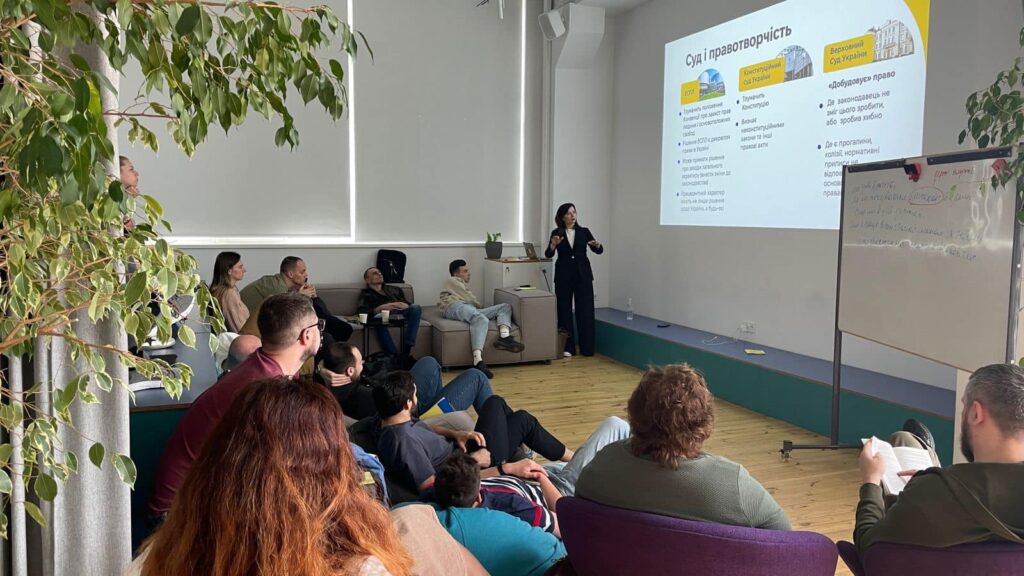
“Jus est ars boni et aequi”— the law is the art of good and just.
With this phrase, Tetiana Havrysh began her discussion on how to implement reforms without causing harm.
Tetiana, who is not only a co-founder and Director of Strategic Development at "Health Solutions," but also an experienced lawyer, and her team have been involved in healthcare changes since 2015, from the autonomy of medical institutions to the establishment of medical self-governance.
The main topics we covered included:
- The perspective of legal understanding: how and when "personal freedom" is altered by "state coercion."
- Human-centricity in law and medicine: procedures are important, but people are more important.
- The evolution of the Constitution of Ukraine.
- Principles of law-making and optimal regulatory frameworks.
We have already conducted three training sessions for the Department of Health team.
On March 15, Serhiy Dyoma led the first training session.
He is a senior advisor on military issues at the international organization CIVIC (Center for Civilians in Conflict), and discussed NATO’s structural management bodies. The team gained knowledge about the distribution of responsibilities and functions within the JGS command structure (S - battalion and brigade level, tactical level; G - branches of military service, operational level; J - combined, strategic level) and NATO doctrine architecture. "The system can be adapted to the realities of our state during wartime," explains Serhiy Dyoma, "but for Ukraine to cooperate with NATO, it is important to have a unified framework."
On March 15, we also held a training session on the "Super System of Healthcare in Ukraine."
Using examples from countries like Sweden, Norway, and Singapore, we explored how to find a balance to provide the highest quality treatment for the wounded while ensuring that civilians do not face barriers to accessing medical care. We discussed human capital and the differences in planning during peacetime versus "special" periods. The speaker was Oleg Petrenko, founder and first head of the NHSCU, and author of the study "Human and Military Medicine - A Comprehensive Perspective."
On March 30, the third training session took place.
We discussed the history and political context in which various healthcare systems were created and developed, including Bismarck, Beveridge, and Semashko. We analyzed why Ukraine inherited a "feudal" healthcare management system from the Soviet Union and examined the experiences and challenges of the Ukrainian healthcare reform. The speaker for this module was Pavlo Kovtoniuk, former Deputy Minister of Health and co-founder of UHC.
For more information on the research, please visit: Human and Military Medicine - A Comprehensive Perspective.